
Translate This Page

Biography
Naza is a Brazilian-born American artist whose work has been exhibited in prestigious museums and major galleries across North, Central, and South America, as well as Europe. She pioneered the style of "Abstracted Realism," a technique where she applies the principles of realism—such as volume, depth, and light—to abstract forms, or deconstructs realistic subjects through the lens of abstraction. Her work ensures that even the most abstract shapes possess a physical presence and weight that words cannot fully convey.
From the outset of her career, Naza consciously avoided the study of contemporary trends to ensure the purity of her own vision. This unique voice has led her art into the private collections of world leaders and icons, including former Presidents Barack Obama, Bill Clinton, Fernando Henrique Cardoso, and Dilma Rousseff, as well as the Ayrton Senna Institute, Brigitte Bardot, Roberto Carlos, the Florida Marlins, and the West Point Academy.
Her career has been documented and celebrated extensively by leading global media, including The New York Daily News, Museum and Arts Magazine, The Miami Herald, Veja, and Folha de São Paulo. Additionally, her life and artistic journey are the subject of a published biography written by the journalist Suzane Jales.
Beyond the studio, Naza has been a highly active member of the South Florida artistic community since 1993. While her work often explores the human figure and the natural world, her true mastery lies in her ability to convey profound emotion through any subject matter. Her art remains a vehicle for environmental, scientific, and charitable advocacy, ensuring her global legacy is intertwined with her dedication to the world around her.
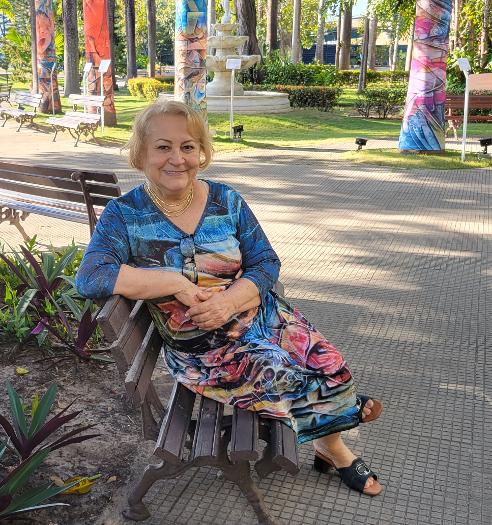
Naza at her outdoor installation, Naza in Nature, wrapping 20 tree trunks at the Universidade de Fortaleza (UNIFOR).
NAZA'S BIOGRAPHY BOOK BY SUZANE JALES
This edition is sold out. Keep tuned for the new edition.

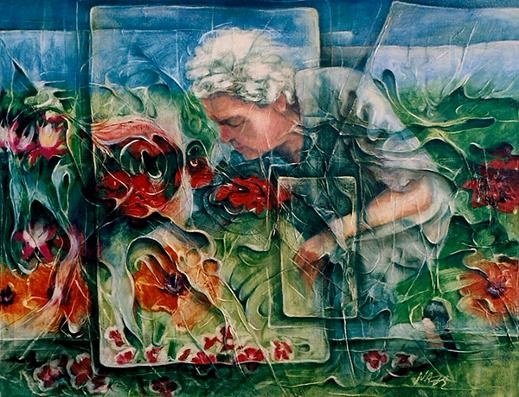
The First Art Commission in Internet History
Back in the mid-90s, I launched my website (www.naza.com). At that time, almost nobody knew how to attract visitors to a website or build an email list of prospective clients. The most common responses I received when I told people I had a website were: “What is that?”, “I don’t have a computer,” and “I don’t have access to the internet yet.” Later on, those were replaced by: “My son is the one who uses the computer.”
Determined to find any tool that could help me spread the word, I discovered Yahoo Chat. I would go from chat room to chat room, copying and pasting the exact same invitation: “You are invited to visit my art exhibition.” Some users followed me into other rooms to start a conversation, and they invariably checked out my website. Based on our chats, I added them as friends and kept notes to track potential collectors.
Through that approach, I built wonderful personal friendships and found serious collectors. One of them was Tim Hulings, from West Virginia. He hired me to paint an oil painting of his 90-year-old mother in her garden. At first, I felt a bit nervous and cautious. Still, I chose to take the chance: I flew to Washington, D.C., rented a car, and drove across the mountains and the Shenandoah Valley to the very end of a road past a small West Virginia town. The road ended literally in Mrs. Hulings’ front yard.
It was a gorgeous, sunny spring day. Next door sat another property with a vast front pasture where horses were grazing, and I recognized the red barn Tim had described online. The silence was absolute. Suddenly, a wave of fear hit me: What if this was a trap set by some stranger to get me out in the middle of nowhere alone with him? The only precautions I had taken were leaving my itinerary and directions with my ex-husband in Arlington, Virginia, and carrying my first cell phone, which gave me a small sense of security.
I knocked on the front door, but nobody answered. I called out several times, but heard nothing. Having traveled that far, I refused to turn back without fulfilling my assignment. Since there was no fence, I walked around to the back garden. I remembered Tim telling me in the weeks leading up to my trip that he had been talking to his mother’s flowers, coaxing them to stay in bloom and wait for my arrival before they faded, knowing how fleeting some blossoms can be.
Then I saw her. Mrs. Hulings was kneeling beside a flower bed, keeping company with a very old sheep and an even older dog. I walked over, introduced myself, and explained why I was there. She smiled warmly and welcomed me. I asked if I could take photographs while she tended to the flowers, and she happily agreed.
About thirty minutes later, Tim arrived on his lunch break. It was wonderful meeting an online friend in person for the very first time. While talking, I asked if I could paint his mother actively caring for her garden rather than just depicting the landscape alone. He loved the idea. Following our meeting, I drove back to the D.C. area, flew home to Florida, and painted the canvas using my reference photos.
“A reporter who later interviewed me for the Sun-Sentinel shared that the finished painting became the centerpiece of a wonderful birthday celebration for Mrs. Hulings.”
— Fort Lauderdale Sun-Sentinel
Over time, I lost touch with Tim after his email address changed. Those early Yahoo Chat rooms have long vanished, but several virtual connections made back in 1995, 1996, and 1997 turned into lifelong friendships—and some became my loyal collectors, too.
— Naza